Wednesday, October 5, 2022

Town Hall Reflection: Mock Trial State v. Mann

During our class Mock Trial presentation, we heard about the case of State v. Mann. Prior to our discussion in class, I had little to no insight as to what the case was about or any of its contents. In terms of the case we were looking at here, let’s start with some background information. In 1829, Elizabeth Jones hired out one of her slaves named Lydia to a man by the name of John Mann. It seemed as if Lydia was treated poorly and punished often during her time with Mr. Mann. As a result she began to run away when Mann shot and wounded her. This was the story all according to John Mann of Chowan County. The county tried him and found him guilty of assault and battery and was fined five dollars. He was unhappy with this judgment, calling it “unjust” and the debate over right from wrong sparked from there.


State v. Mann - North Carolina History Project


Now, since the lower county court gave him the guilty verdict, he was able to appeal to the higher courts. According to NCSU in State v. Mann (1892), a North Carolina Supreme Court judge by the name of Thomas Ruffin ruled in favor of the defendant, as did the overall court in the end, saying that “One who has a right to the labor of a slave, has also a right to all the means of controlling his conduct which the owner has”. It was interesting to hear about all the different points made off of this general ideal and while it was not surprising this was the decision made in this time, it was disgusting to hear that people were so willing to condone slavery. Further, that they were able to condone the harsh and brutal physical treatment these slaves often endured. 


Race, Economics, and the Persistence of Slavery | AAIHS


This case was entirely new to me so all of it was new territory for me. However, what was really eye opening to me, again, was the decision the Supreme Court of North Carolina made and the feeling of the public continuously towards slaves. The opinions from all those on Mann’s side continuously justified and condoned slavery. This did seem to be a societal norm, but as someone who never lived in that time it is a lot to understand. Especially, like in this case, with slavery still being legal in some states. The overall feeling was that a slave owner had complete control over their slaves and how they chose to treat them as well as how they allow others to treat them. 


U.S. Slavery: Timeline, Figures & Abolition - HISTORY


I am in complete disagreement with this as I not only do not believe in the idea of slavery but I especially do not believe in the extreme mistreatment of them. I believe that the county was completely on the right track with their verdict and the Supreme Court should have followed through. Instead, the nation allowed the mistreatment of slaves to go on for much longer than that. Even if you ignore the morality surrounding the case, the straight facts give you a clear verdict. Lydia was property of Elizabeth Jones and as a result, John Mann’s choice to overstep and treat the slave as his own should have resulted in much deeper consequences. 


Sources:

https://www.lexisnexis.com/community/casebrief/p/casebrief-state-v-mann

https://en.wikipedia.org/wiki/North_Carolina_v._Mann

https://www.ncpedia.org/state-v-john-mann

https://northcarolinahistory.org/encyclopedia/state-v-mann/

https://cwnc.omeka.chass.ncsu.edu/items/show/44#:~:text=North%20Carolina%20Supreme%20Court%20judge,still%20possessed%20the%20power%20to

Bleeding Kansas

What was Bleeding Kansas?

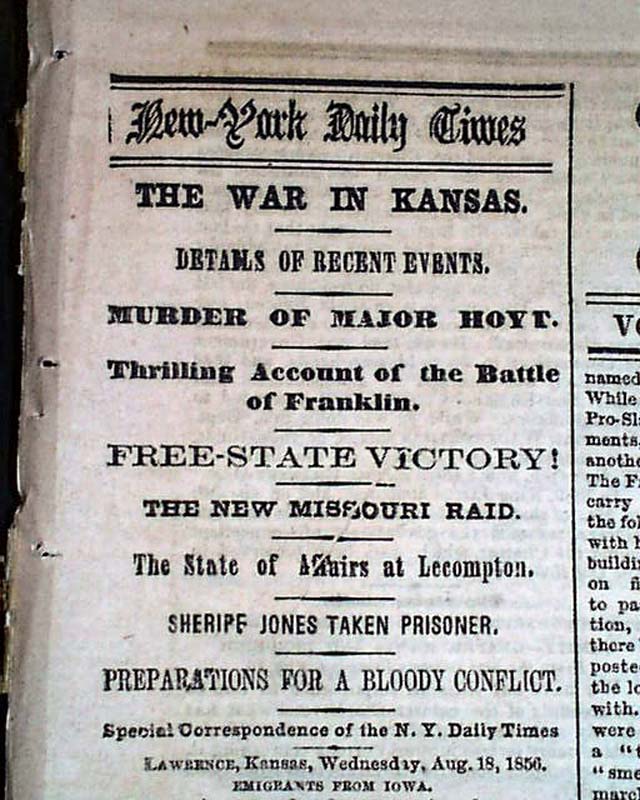
Between the years of 1854 and 1859, Bleeding Kansas, also known as Bloody Kansas or the Border War, was a small war that broke out in the United States, violence occurring all along Kansas territory and into western Missouri. The war broke out between proslavery and antislavery advocates alike all over control of Kansas territory under popular sovereignty and the legality and morality of slavery in Kansas, a political and theological debate. The Kansas-Nebraska Act of 1854 was set to hopefully eliminate the tensions between the sides over land, allowing for territorial self-government but ultimately, that did not work. Instead, antislavery advocates banded together to populate Kansas while proslavery advocates came in from Missouri in hopes to claim it as a slave state. This led to the destruction left behind by Bleeding Kansas.


Bleeding Kansas - Summary, Causes & John Brown's Role - HISTORY

“Bleeding Kansas describes the period of repeated outbreaks of violent guerilla warfare between pro-slavery and anti-slavery forces following the creation of the new territory of Kansas in 1854”

-History.com Editors Apr. 7, 2021


Where it All Began

When the Kansas-Nebraska Act was passed in 1854, by Senator Stephen A. Douglas, it not only repealed the Missouri Compromise making Kansas a free state, but it created the territories allowed for popular sovereignty. This is known to be the decisions amongst the people as to whether or not territories would become free states or slave states. While some people genuinely arrived at that territory just looking to settle, most were politically motivated antislavery and proslavery settlers looking to add the state to their list of followers. Then started a mini civil war known as Bleeding Kansas.


The Kansas-Nebraska Act of 1854 - History


A Nation Divided

The state eventually divided into capitals, having a proslavery capital in Lecompton and an antislavery capital in Lawrence and Topeka. The anger, opposition and violence ensued over time. Both sides fought fiercely in an effort to lean the state majority one way or the other. Proslavery activists were in such support of their cause Senator David Atchison led over 1,700 men from Missouri over into the border of Kansas. These men became known as “Border Ruffians” which would attack people and threaten them to be shot or hanged should they choose to oppose slavery. These men were originally brought over to just cast a vote for their representation, but obviously, this would be just one of the many examples of violence amongst the people during Bleeding Kansas. Proslavery gained the numbers and antislavery settlers were vastly outvoted. This was a big win for the proslavery movement as it passed a harsh legislature, got their leaders appointed and gained support.


Bleeding Kansas and the Kansas-Nebraska Act | C-SPAN.org


Then What?

As time progressed, the antislavery population in Kansas increased greatly and they began to far outnumber those on their mission to be proslavery. They became organized and known as the “Free Soilers” who came up with their own free state system of government and legislature, even with their own leaders all located in Topeka. Naturally this was not received well. Antislavery followers and leaders were pushing to introduce their legislation all the while proslavery followers were doing the same. Furthermore, abolitionist followers such as John Brown (see below for his story) and his sons committed many crimes to further the efforts of the movement, whichever side they supported between proslavery and antislavery, that is. Though this was a very drawn out dispute, it didn’t really accumulate many deaths. In fact, it is said to have killed about 55 people. Regardless, after Bleeding Kansas was entirely over, many things came to follow. Let’s discuss SOME of the crucial ones. 


Bleeding Kansas... - RareNewspapers.com


The Damage is Done

For one, it became one of the top initiators of the Civil War and in some cases only furthered the argument on slavery. Politics were in a complete uproar even resulting in the destruction of some political parties, such as the old Whig coalition, and creation of others, such as the Republican Party. Violence ensued, including beating Senator Charles Sumner to the ground for being an antislavery Republican. Also, the sacking of Lawrence when proslavery settlers ransacked Lawrence, Kansas to emphasize their mission on making Kansas a slave state. Everything mentioned is just some of what happened during the time and shortly after the mini-war known to be Bleeding Kansas. In the end, antislavery settlers were victorious and Kansas became a free state in 1861.


May 24, 1856: John Brown and the Pottawatomie Massacre | Black Then

John Brown and the Pottawatomie Massacre (May 24-25, 1856)

In May of 1856, five men who were currently living on the proslavery settlement on Pottawatomie Creek in Franklin County, Kansas were murdered in cold blood in the dead of night. This became known as the Pottawatomie Massacre. A radical abolitionist by the name of John Brown took some friends and family members to the settlers cabins to seek vengeance for the sacking of Lawrence days prior, attack on Charles Sumner at the U.S. Senate and the proslavery movement altogether. John Brown chose to make a stand for his faithful cause and show loyalty to the people, but what happened was perhaps more than he bargained for. This event sparked much of the violence, anger and terror that surrounded the years of Bleeding Kansas.


Sources:

​​https://en.wikipedia.org/wiki/Bleeding_Kansas

https://www.britannica.com/event/Bleeding-Kansas-United-States-history

https://ohiohistorycentral.org/w/Bleeding_Kansas

https://www.senate.gov/artandhistory/history/minute/Kansas_Nebraska_Act.htm

​​https://www.ushistory.org/us/31b.asp

https://www.history.com/topics/19th-century/bleeding-kansas

https://civilwaronthewesternborder.org/encyclopedia/pottawatomie-massacre

Klansville, U.S.A.

North Carolina was given the nickname “Klansville U.S.A” during their rise to fame in the 1960s. The leader of the Klan, Bob Jones, had a st...